


Adafruit
Adafruit Grand Central M4 Express SAMD51 Development Board - IR0000515
Adafruit Grand Central M4 Express SAMD51 Development Board - IR0000515
SKU:IR0000515
Earn an estimated 52 points on this order
Found a better price?
Send the competitor link and price to our team. No automatic price match.
Couldn't load pickup availability
- For Bulk Order Click Here
- Need Customer Support?
- Free Delivery Above 999/-
Note: In case you receive a damaged or faulty product, please return it in the original box with all foam and packaging. Returns will not be accepted if further damage occurs due to improper packing.
If you order a product that is currently in Preorder, and the price of that item increases in the future, you will be required to pay the difference in price.
For refund/return/replacement, call us at +91 95995 94520 or email us at support@rees52.com
Delivery Time
Delivery Time
- Delivery time with the Express Shipping option is 2-3 working days, and with the Standard Shipping option is 5-6 working days. It varies based on location, reliant on courier services.
- Delivery time if the order item is on Preorder Status is 15-20 working days.
COD (Cash on Delivery)
COD (Cash on Delivery)
Cash on Delivery is currently unavailable for new orders
Existing COD Orders Only
- For COD you have to pay extra charges of Rs 350/- before the shipment. (We will share the company QR Code, UPI ID or Account details for the same)
The REES52 Promise
The REES52 Promise
We want you to build, not worry. Here is exactly what happens if something goes wrong with your order.
Dead on arrival or defective? We replace it.
If your item is dead on arrival or has a manufacturing defect, tell us within 7 days of delivery. Email support@rees52.com with your order number and a short video or a couple of photos showing the problem. Our team will get back to you within 24 hours and arrange a free pickup from your doorstep - you never pay return shipping for a defective item. Once we verify the issue, your replacement ships out right away. If the item is out of stock, you get a full refund instead.
Refunds, with real timelines.
- Approved refunds go back to your original payment method within 6-7 working days.
- Missing item in your package? Tell us within 7 days with photos of what arrived and the parcel label. Once confirmed, the refund for the missing item reaches you in 2-3 working days - or we ship the missing piece free, your choice.
- Every refund comes with a reference number by email or WhatsApp, so you can track it with your bank instead of chasing us.
Wrong item or not as described?
Email us your order number and a photo of what you received. We arrange the return pickup, and ship the correct item as soon as the return is on its way. Prefer your money back instead? That is fine too - full refund, same 6-7 working day timeline.
About lead times on some products.
A few items on rees52.com are sourced from our overseas partner warehouses and are not sitting on our shelf. Those products show a lead time of about 20-25 working days on the product page, before you pay. If you order one, we keep you posted as it moves. Changed your mind while waiting? You can cancel any time before dispatch and get a full refund within 6-7 working days. No cancellation fee, no questions.
Talk to a human.
Email support@rees52.com or call/WhatsApp +91 95995 94520, Monday to Saturday, 10:30 AM to 7:00 PM. Real people, order number in hand, actual answers.


Adafruit Grand Central M4 Express
Build projects with more connections, storage and processing power on a single development board. The Grand Central M4 Express combines a 120MHz Microchip ATSAMD51P20 Cortex-M4 processor with floating-point and DSP support, 1MB internal flash and 256KB RAM. Its large, Arduino Mega-style layout gives you room for robotics controls, instruments, data logging and custom user interfaces.
Native USB, an onboard microSD socket and 8MB QSPI flash support both interactive projects and stand-alone applications. Use Arduino or CircuitPython, following the maker's board-specific setup instructions and checking library support for the peripherals you plan to connect.
Important board and photo notes
PCB colour may be black or purple. Adafruit supplies both colours for this product. Photos show the board and example applications, not an assurance of a particular PCB colour.
Status LED silkscreen caution: Adafruit documents misprinted status LED labels on early boards. The corrected physical sequence is ON, TX, RX, L, as shown in the official pinout guide. Use that corrected diagram rather than relying on early printed labels. A board with revised labels is not promised.
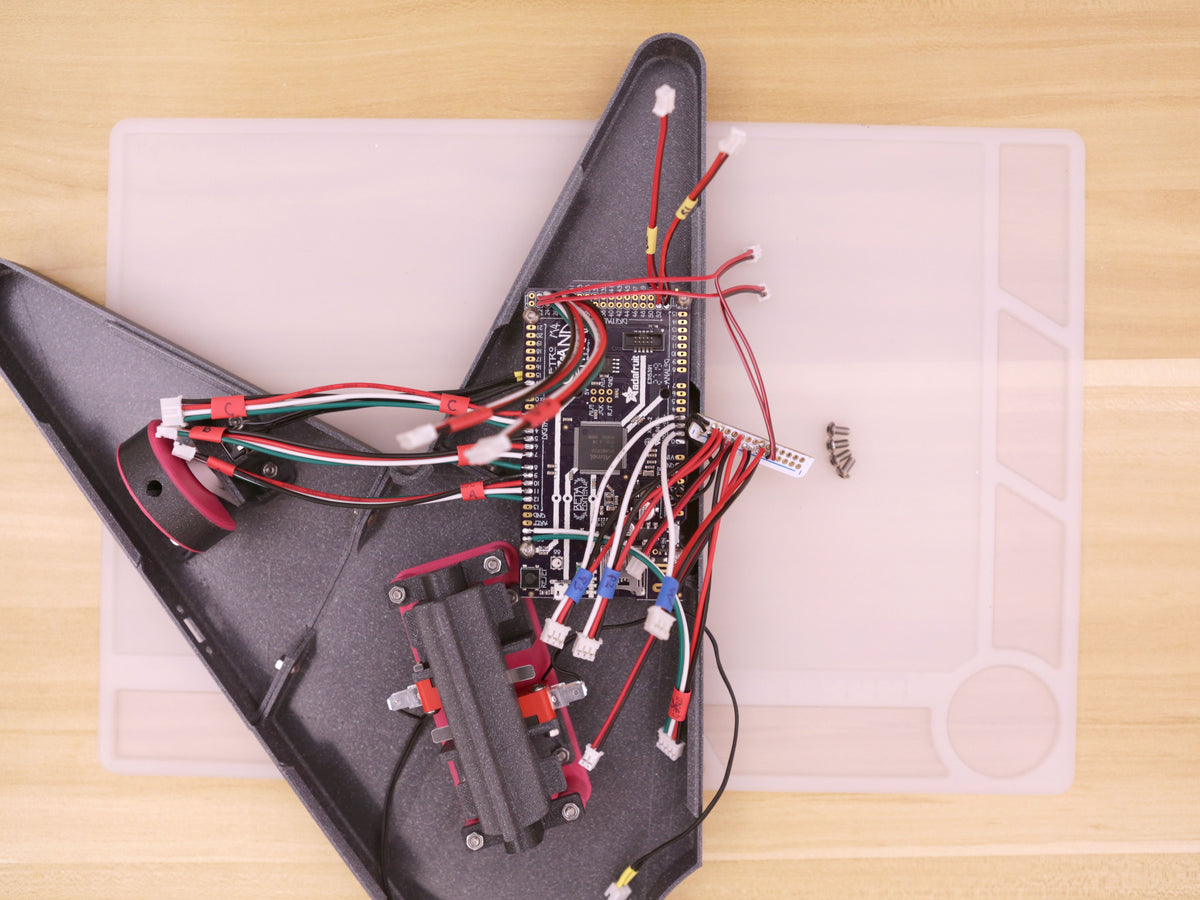
Application photos are examples only. The coin, standoffs, mounting screws, wires, potentiometers, switches, sensors, prototyping boards, guitar body, enclosure, cables, power adapter and other external parts shown are not included. The supplied package is listed below.
Features
- 120MHz Cortex-M4 processor with hardware floating point and DSP instructions.
- Large Mega-style board with fitted socket headers and extensive digital and analog connections.
- Native USB for programming, serial communication and supported USB device applications.
- 8MB QSPI flash for program files and storage, plus a separate SPI-connected microSD slot.
- Two true analog DAC outputs on A0 and A1, with analog inputs on A0 through A15.
- Configurable SERCOM interfaces for additional I2C, SPI or UART connections, subject to pin multiplexing and software support.
- Onboard NeoPixel, status LEDs and reset button.
- UF2 bootloader supports drag-and-drop firmware installation.
Technical specifications
| Board | Adafruit Grand Central M4 Express, maker product 4064 |
|---|---|
| Microcontroller | Microchip ATSAMD51P20, ARM Cortex-M4 |
| Processor clock | 120MHz |
| Internal flash / RAM | 1MB / 256KB |
| Logic voltage | 3.3V |
| External flash | 8MB QSPI |
| Removable storage | microSD socket, SPI interface; card not included |
| Analog connections | A0 through A15 inputs; A0 and A1 also provide DAC output |
| Interfaces | Native USB, SPI, I2C, UART and configurable SERCOM peripherals |
| USB connector | Micro-USB |
| Power options | 5V USB or 6-12V centre-positive 2.1mm DC input |
| Development options | Arduino and CircuitPython |
Connection and use
- Connect the board to a computer with a known-good Micro-USB data cable, purchased separately.
- Follow the official guide to install the appropriate board support and firmware. Check the bootloader update instructions when using current operating systems.
- Connect external hardware using the board pinout. All I/O logic is 3.3V; do not assume that a shield is electrically compatible merely because it fits the Mega-style headers.
- Use the onboard QSPI flash or a separately purchased microSD card for storage. The card socket uses SPI, not SDIO.
The DC power switch affects the DC jack supply, not USB power. Disconnect power before changing wiring. Motors, solenoids and other high-current loads need suitable external drivers and power supplies; do not drive them directly from GPIO pins. Analog conversion speed, effective resolution and USB behaviour depend on firmware and configuration.
Package includes
- 1 x Adafruit Grand Central M4 Express development board.
- 4 x rubber bumpers.
Useful links
- Adafruit official product page
- Grand Central setup and programming guide
- Pinouts, power limits and corrected LED labels
- UF2 bootloader update instructions
- MIDI guitar application guide
- Supplier product and package reference
Photo credits
Product photos by Kattni Rembor via Adafruit Learning System: angled top view, rear view and connector end view. Application photos by Ruiz Brothers via Adafruit Learning System: mounting example, MIDI wiring example and guitar installation example. Licensed under Creative Commons Attribution-ShareAlike 3.0. Images resized and JPEG-encoded for this listing. Adapted images remain under the same licence.